National Regulations and Frameworks
South Africa is regarded as a pioneer of responsible investment in emerging markets.
Various regulatory requirements have been introduced and voluntary initiatives have been developed that promote responsible investment practices in South Africa.
While these developments are encouraging, implementation has not always matched expectations.
South Africa is regarded as a pioneer of responsible investment in emerging markets.
Various regulatory requirements have been introduced and voluntary initiatives have been developed that promote responsible investment practices in South Africa.
While these developments are encouraging, implementation has not always matched expectations.
Code for Responsible Investing in South Africa (CRISA)
Regulations
The National Treasury has articulated clearly that the aim of retirement fund investment regulation is to ensure that the savings South Africans contribute towards their retirement are invested in a prudent manner that not only protects the retirement fund member, but also supports economic development.
Consistent with these goals, the National Treasury incorporated the concept of RI into the revisions made to Regulation 28 of the Pension Funds Act in 2011.
The most relevant statements can be found in the Preamble section, which states:
Regulation 28 Preamble:
A fund has a fiduciary duty to act in the best interest of its members whose benefits depend on the responsible management of fund assets. This duty supports the adoption of a responsible investment approach to deploying capital into markets that will earn adequate risk adjusted returns suitable for the fund’s specific member profile, liquidity needs and liabilities.
Prudent investing should give appropriate consideration to any factor which may materially affect the sustainable long-term performance of a fund’s assets, including factors of an environmental, social governance character.
This concept applies across all assets and categories of assets and should promote the interests of a fund in a stable and transparent environment.
And under the Principles, particularly in Clause 2(c)(ix), which states:
Excerpt from Regulation 28 – Principles:
- (2 a) A fund must at all times comply with the limits as set out in this regulation.
- (2 b) A fund must have an investment policy statement, which must be reviewed at least annually.
- (2 c) A fund and its board must at all times apply the following principles:
- promote the education of the board with respect to pension fund investment, governance and other related matters;
monitor compliance with this regulation by its advisers and service providers;
in contracting services to the fund or its board, consider the need to promote broad-based black economic empowerment of those providing services; - ensure that the fund’s assets are appropriate for its liabilities;
- before making a contractual commitment to invest in a third-party managed asset or investing in an asset, perform reasonable due diligence taking into account risks relevant to the investment including, but not limited to, credit, market and liquidity risks, as well as operational risks for assets not listed on an exchange;
- in addition to 5, before making a contractual commitment to invest in a third-party managed foreign asset or investing in a foreign asset, perform reasonable due diligence taking into account risks relevant to a foreign asset including but not limited to currency and country risks;
- in performing the due diligence referred to in (v) and (vi), a fund may take credit ratings into account, but such credit ratings should not be relied on in isolation for risk assessment or analysis of an asset, should not be to the exclusion of a fund’s own due diligence, and the use of such credit ratings shall in no way relieve a fund of its obligation to comply with all the principles set out in paragraph 2(c);
- understand the changing risk profile of assets of the fund over time, taking into account comprehensive risk analysis, including but not limited to credit, market, liquidity and operational risk, and currency, geographic and sovereign risk of foreign assets;
- and
before making an investment in and while invested in an asset consider any factor which may materially affect the sustainable long-term performance of the asset including, but not limited to, those of an environmental, social and governance character.
- promote the education of the board with respect to pension fund investment, governance and other related matters;
- (d) With the appointment of third parties to perform functions which are required to be performed in order to comply with the principles in (c) above, the fund retains responsibility for compliance with such principles.
FSCA Guidance Note 1 of 2019 provides guidance for boards of retirement funds on how to comply with the parts of Regulation 28 that address sustainability, particularly how its investment philosophy and objectives are reflected in the investment policy statement (IPS).
The guidance also sets out the FSCA’s expectations for reporting and disclosure on sustainability issues. According to the Guidance Note, the IPS should address how a fund intends to monitor and evaluate the ongoing sustainability of its assets, including the extent to which ESG factors have been considered and the potential impact of these factors. It should also include its active ownership policy.
The FSCA encourages transparent disclosure. There are various guidelines on the disclosure of information to stakeholders including that the IPS should be made available on the fund’s website and, on an annual basis, stakeholders should be informed of any changes to the IPS.
Funds are requested to report on the extent to which the IPS reflects the issues covered by the Guidance Note, while additional information such as the value of assets held in compliance with the Guidance Note should be included as notes in the financial statements.
Voluntary Frameworks
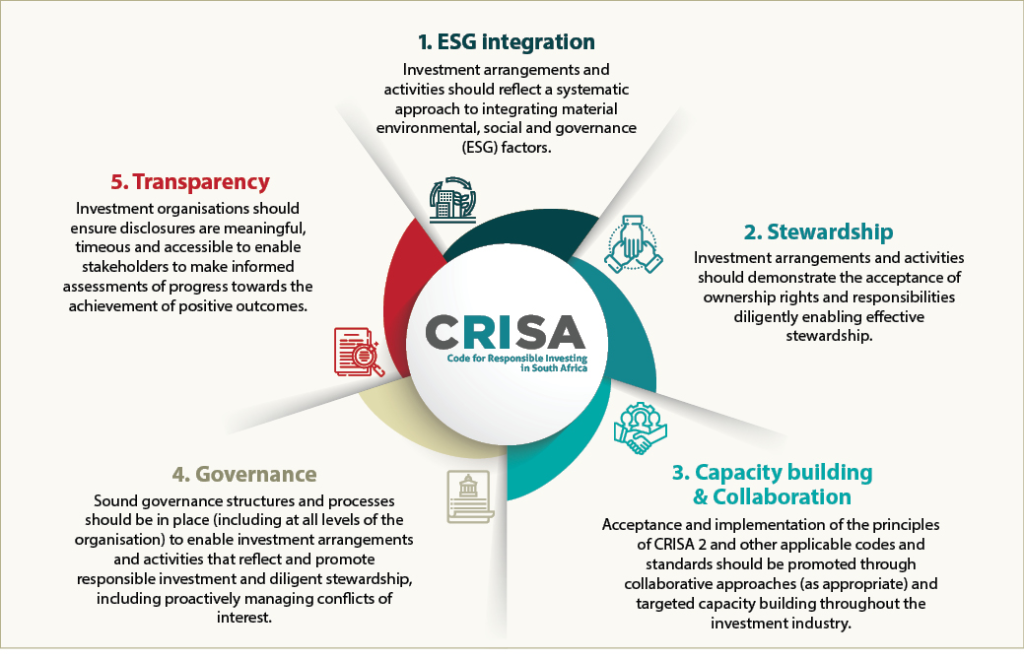
The Second Code for Responsible Investing in South Africa (“CRISA 2”), which was released in 2022, provides asset owners with a domestic framework of five principles for effective stewardship and responsible investment practices. It builds on the first CRISA Code, which was launched on 19 July 2011.
The central objective of CRISA 2, which is endorsed by the FSCA, is to reaffirm responsible investment as a key component of the South African governance regime and provide a framework of principles for stewardship.
CRISA applies to asset owners such as pension funds and insurance companies and their service providers including asset managers and consultants. It encourages institutional investors and service providers to adopt its principles and practice recommendations on an ‘apply or explain’ basis.
The five principles of CRISA 2 are:

Asset owners should consider applying the principles set out in the King IV Supplement for Retirement Funds as part of good governance of retirement funds.
The Supplement supports responsible investing principles and practices and encourages ESG integration and active ownership as part of being a responsible actor. It recommends that funds disclose in accordance with CRISA to enable stakeholders to make informed decisions.
The King Code is a widely adopted voluntary code that guides corporate governance in South Africa through the application of 17 principles and supports implementation across all sectors through “sector supplements”.
The 17 Principles of King IV:

South Africa’s National Development Plan (NDP), which was launched in 2012, aims to “eliminate poverty and reduce inequality by 2030…by drawing on the energies of its people, growing an inclusive economy, building capabilities, enhancing the capacity of the state, and promoting leadership and partnerships throughout society.”
The NDP proposes various objectives and action across areas such as economic infrastructure, environmental sustainability, human settlements, education, fighting corruption and social cohesion.
There is a significant overlap between the NDP and the SDGs. Asset owners should consider how their investments are aligned with the NDP and SDGs.
This can assist with identify potential real-world impacts that can help in achieving a more sustainable world.
The South African Green Finance Taxonomy, which was released in March 2022, provides a catalogue of assets, projects and sectors that can be defined as “green” in accordance with international best practice and national priorities.
Benefits to the financial sector include greater clarity and certainty in selecting and issuing green financial instruments and stronger regulatory oversight. For asset owners, taxonomies are likely to become increasingly important as they can help with the construction of sustainable portfolios by identifying sustainable investment opportunities.
They also enable consistent disclosure of investments aligned with the taxonomy.