STEP Four
Selecting Service Providers
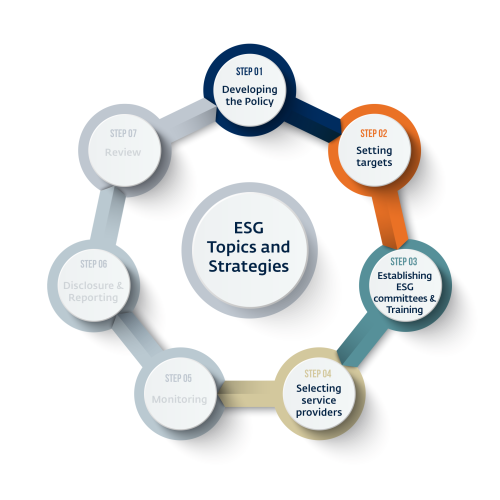
Once policies and strategies are set to cover ESG, Stewardship and Conflicts of Interest, the Board of Trustees needs to ensure that these are executed by its service providers.
This section provides an overview of the selection process and checklists of questions to ask service providers. Selecting Service Providers
Step 4
Selecting Service Providers
The Board of Trustees needs to ensure that its commitments on ESG integration, Stewardship, and Conflicts of Interest are executed by the fund’s service providers.
ESG considerations should be integrated into the selection and appointment process for investment consultants, asset managers, legal advisors and voting service providers.
The overarching question is to establish whether service providers’ practices are aligned with the fund’s responsible investment objectives, strategies and beliefs as reflected in the ESG-integrated IPS. Being registered with the PRI and/or endorsing the principles contained in CRISA can signal whether a service provider is likely aligned, however, a fund should be asking more specific questions to evaluate actual practices.
This section focuses on the critical aspect for effective implementation of selection and appointment of investment consultants and asset managers and the incorporation of ESG considerations into Appointment Letters and Investment Mandates.
Investment Consultant Selection
Many Boards of Trustees work extensively with investment consultants on various aspects of their fund management. Historically, investment consultants have often based their advice on a narrow interpretation of investment objectives focused on financial returns.
However, increasing amounts of data on the link between ESG and investment performance is showing that neglect of ESG issues can lead to asset owners mispricing risk and making poor investment decisions. While the major consulting firms now have RI specialists, or teams focused on responsible investment, these are usually established as separate advisory centres rather than being integrated into all investment advisory services. This results in ESG being an additional service and cost.
Conversely, a common point of feedback from investment consultants is that pension funds rarely raise responsible investment issues with them, which limits their willingness to integrate responsible investment into their mainstream service offerings.
An investment consultant typically advises on some or all the elements in:
- Investment strategy– including defining fiduciary obligations; formulation of investment principles, and strategy and investment policy.
- Asset manager selection – including mandate formation; research and long-lists; requests for proposal; screening and shortlist; and appointment.
Investment strategy
Investment consultants can play a key role in various stages of the development of an investment strategy.
- Setting investment beliefs or principles. A good consultant should be able to provide a framework for discussing and workshopping beliefs based on appropriate evidence, and be able to summarise them effectively.
- Translating investment beliefs into objectives and criteria. A consultant can conduct scenario and other investment modelling to inform the asset owner’s decision on the investment strategy across the available investment universe. Consultants can advise on which asset classes, sectors and geographies should be focused on.
- Advise on the ESG investment strategies and products available. A consultant should have good knowledge of the various products available. They can provide examples of strategies that have been adopted by other asset owners, including examples of how ESG issues have been considered and of how these have affected investment performance and wider organisational objectives.
- Develop investment policies that codify the asset owner’s investment strategy. In relation to its investment decision-making and asset allocation processes, and its approach to ESG incorporation, stewardship, manager selection and monitoring.
An investment consultant can also support on asset manager selection, the process for selection should be similar if outsourced to an investment consultant.
Trustees should question the ESG capacity of investment consultants in both investment strategy and fund manager selection as part of their investment consultant selection process. Consultants should be prepared to explain their approach and to offer solutions. Consultants’ answers to the questions will provide the basis for a gap analysis that can be used to compare consultants, or for an in-depth conversation on missing areas.
Key questions to support the selection of an investment consultant include:
- How does the investment consultant consider ESG issues in the advice that it provides clients?
- What capabilities does the investment consultant have in Responsible Investing?
- Does the investment consultant have a set of its own principles in relation to incorporating ESG considerations into its business practices and advice to clients?
- Does the investment consultant have a structured process it follows to help clients develop their investment principles?
- Can the investment consultant provide examples of where a client adopted ESG issues into their investment policy or principles due to the consultant’s advice?
- What were the (dis)advantages or drivers for the client adopting such principles?
- Does the consultant survey RI practices of asset managers alongside standard metrics?
- How does the investment consultant evaluate an RI fund, i.e. the product?
Further questions to support retirement funds in selecting an investment consultant are provided here.
Asset Manager Selection
Manager selection is a core component of pension funds’ investment process. Trustees often engage the investment consultants to help with this step, but it should be noted that ultimate responsibility for manager selection sits with the Board of Trustees. The manager selection process should typically follow three steps of longlisting, shortlisting, and final in-depth due diligence.
Before commencing the selection process the fund should define the mandate that fits their ESG requirements as formulated in the IPS and is aligned with the fund’s investment principles, beliefs and strategies. Asset managers should then offer products in accordance with the pension fund’s investment preferences. These might be tailored products that directly match the mandate – if running a separate client account – or managers might offer existing products that can fit within the asset owner’s investment preferences, potentially in combination with others, (i.e. under a pooled mandate for retail / umbrella funds).
By assessing manager offers against the mandate specification, a longlist and then a shortlist of potential managers should be identified. Research, screening, scorecards, benchmarking and peer reviews can be used to reduce those on the longlist to a shortlist. Shortlisted managers can be assessed in terms of their ESG investment implementation, stewardship processes and responsible investment outcomes. Key selection criteria may be based on the following categories and key questions:
- Governance
- How is responsible investment defined?
- Who is responsible for responsible investment implementation and monitoring at the highest level?
- Who is responsible for responsible investment implementation and monitoring? How are these roles and responsibilities defined and separated?
- What resources and training are available for employees?
- Do you have a responsible investment policy?
- Investment approach and objectives
- What is your overall investment philosophy, including how you believe incorporating ESG factors adds value?
- What are your objectives for ESG incorporation in your investment approach?
- How do you ensure that ESG issues are embedded and systematically feed into all investment decisions?
- What is your approach to stewardship?
- Risk, Return and Outcomes Framework
- Which risks do you monitor through your firm’s research? Is ESG materiality analysed before and after investment decisions?
- What are the major ESG risks you identified in your portfolio and what are you doing to mitigate them?
- Are ESG factors assessed as part of the financial return or separately?
- How do you identify positive and negative outcomes of investment decisions on society and the environment?
- Reporting and disclosure
- How do you communicate ESG integration performance to different stakeholders?
- What accountability mechanisms are in place?
- What responsible investment related initiatives are you signatory to or aligned with?
A longlist of questions on asset manager selection can be found here.
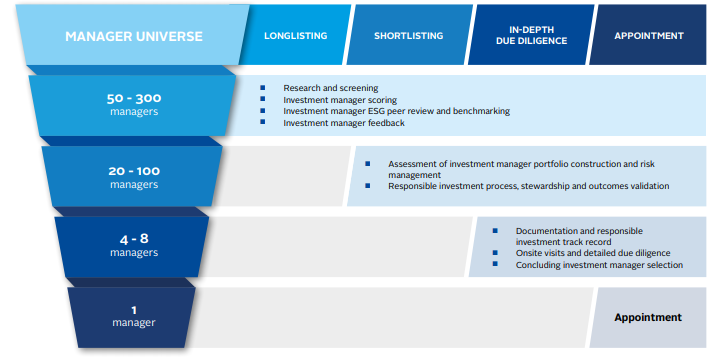
Final selections will require thorough due diligence of the manager’s investment approach and performance, investment process and portfolio construction decisions. Verification of service providers’ ESG information and onsite visits should also be undertaken.
Formal feedback to unsuccessful service providers is an important step to support improved ESG practices.
Once appointed, pension funds should require asset managers to report regularly on:
- how they have systematically integrated ESG issues in their practices and processes
- the investment decisions that have been made as a result of ESG integration, and
- how this has affected investment performance.
In turn, pension funds should also provide feedback to their asset managers on how they are performing against the pension fund’s beliefs and policies, and they should encourage asset managers to continuously improve their practices and processes.
The pension fund should also seek to align interests through fees, pay structures and other incentives. High-performing asset managers should be rewarded, whether through strengthened relationships or through winning new mandates. Evaluation criteria can include product innovation, quality of ESG integration, and quality of engagements with companies and issuers.
Integrating ESG into mandates
Investment mandates are critical to defining the relationship between the asset owner (in this case the pension fund/Trustee) and the asset manager. Mandates influence manager behaviour and help define an asset owner’s ability to project its investment preferences into investment practice.
Addressing ESG in existing mandates:
As investment mandates are generally structured over several years, there is limited opportunity for asset owners to change contract requirements during the term of the mandate. However, several steps can be taken during that time to encourage ESG practices. A pension fund may:
- Share its new ESG integrated policy with its asset managers (ideally having consulted them during its drafting)
- Ask its asset managers to provide information on what they currently do to address ESG issues and stewardship in their investment process
- Provide asset managers with a clear explanation of the expectations that the pension fund is placing on them, and how these expectations are likely to evolve and become more formal over time. As the pension fund’s RI expectations will not be contractual yet, it may be useful to set out a series of practices that the pension fund would like its service providers to adopt, and to then seek agreement (or confirm alignment) on a voluntary basis
- Request asset managers to provide periodic updates on their RI activity (e.g. quarterly, semi-annually or annually)
- When investment mandates come up for renewal, make sure that RI considerations are built into the review and or re-appointment process
Integrating ESG into new mandates:
Asset owners have much greater latitude to integrate ESG requirements into new mandates.
The following key points should be considered in the mandate formation:
- The asset owner’s investment principles and policy as the overall guide
- Requiring that managers include ESG issues in their investment research, analysis and decision-making processes
- Specifying time horizons and risks to portfolio goals
- Asset class or investment style specific expertise
- Stewardship on ESG factors
- Reporting requirements regarding the manager’s actions and outcomes achieved, including ESG factors throughout
When providing Asset Mangers with the relevant policies, proxy voting and engagement strategies are particularly relevant in the SA context given the large allocation to listed equities and the limited universe of investments.
ESG considerations can and should be integrated into investment management agreements (IMAs). Relevant clauses can include:
- Requirements and/or targets relating to ESG integration
- Requirements and/or targets relating to ESG exclusions in mainstream portfolios
- Requirements and/or targets relating to engagement
- Requirements and/or targets relating to voting
- Reporting on the impact of ESG issues on financial (or portfolio) performance and/or the ESG characteristics of the portfolio
- Performance fees dependent on ESG delivery
- Break or renegotiation clauses in the event of a significant change in the organisation’s ESG capabilities, resources, approach or performance
See sample clauses for consideration in the ICGN-GISD Model Mandate (2022).
Further Reading
PRI – Investment Tools – Manager Selection: portal on selecting appointing and monitoring asset managers, which also includes DDQs .
PRI (2019) – Investment Consultants and ESG: An Asset Owner Guide.
PRI (2020) – Asset Owner Technical Guide: Investment Manager Selection Guide