STEP One
Developing The Policy
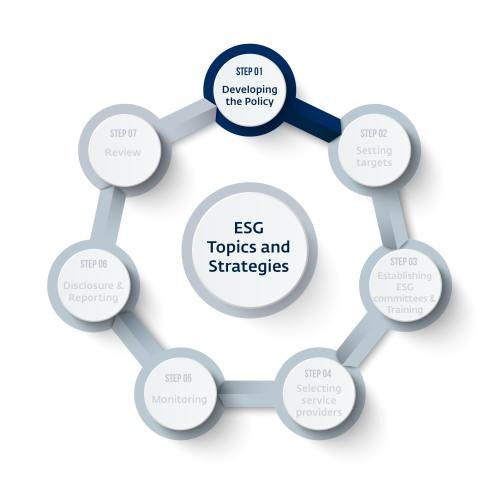
An Investment Policy Statement is an articulation of a fund’s investment philosophy and strategy, and guides its implementation.
In line with South African pension fund regulation, and to protect and enhance long-term returns, this first fundamental step must consider ESG factors.
This step provides key considerations and checklists to support developing an Investment Policy Statement that incorporates ESG.
Step 1
Developing Investment Philosophy and Policy
What Does The Regulation Say?
Regulation 28(2)(c)(ix) of the Pension Funds Act states that a fund and its Board must: “Before making an investment in and while invested in an asset, consider any factor which may materially affect the sustainable long-term performance of the asset, including but not limited to, those of an environmental, social and governance character.”
The FSCA Guidance Notice on the Sustainability of Investments and Assets in the Context of a Retirement Funds Investment Policy Statement (the “FSCA Guidance Notice 1 of 2019”), paragraph 4.1 also states that all pension funds should have a board-approved and publicly available policy (or policies) that explains how ESG factors are integrated into their investment philosophy and strategy.
Formulating the investment philosophy, strategy and policy helps define how the pension fund will create value in the context of future uncertainty, risk, and opportunity. Incorporating ESG into the investment philosophy, strategy and policy is a critical first step for a fund developing an approach to responsible investing and aligning with regulatory requirements.
The figure below outlines the general process for developing investment philosophy, beliefs, strategy, and ultimately codifying them into an Investment Policy Statement (IPS). The IPS reflects what the fund commits to doing on behalf of its beneficiaries and what it expects of others. It helps ensure that all key stakeholders – including trustees, principal officers, consultants, service providers, members and regulators – have an unambiguous understanding of the fund’s objectives and requirements on ESG integration.
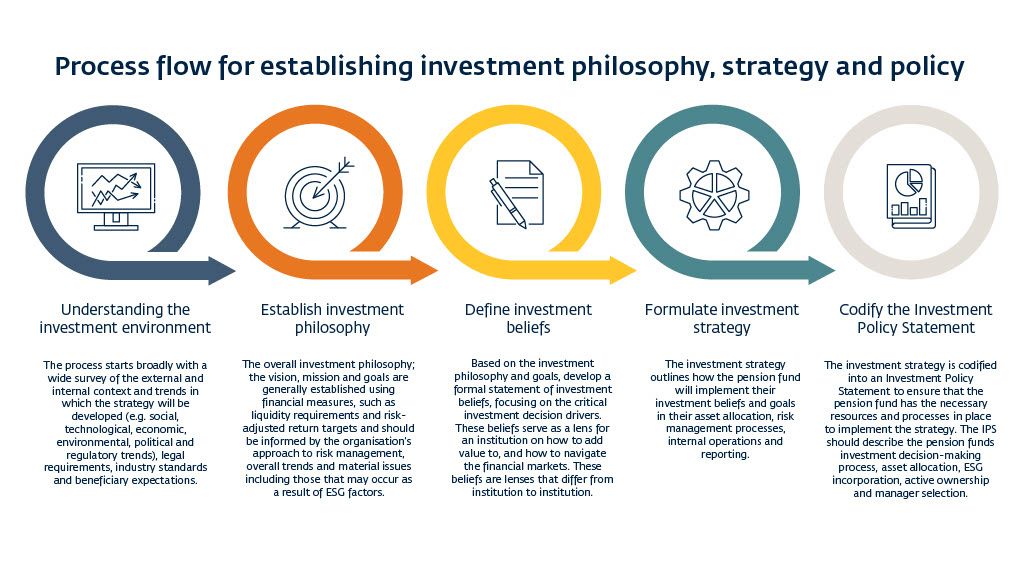
Source: Adaptation from the Responsible Investment Ownership Guide (2013) and How Asset Owners can Drive Responsible Investment (PRI 2016)
- The internal context – including existing fund expertise and resourcing, fund investment goals and characteristics, current investment and risk management strategy.
- The external context – including global and national ESG trends, and ESG factors’ impacts on sectors and asset classes.
- Regulatory and policy requirements related to ESG and investment more broadly.
- Appropriate ESG investment strategies to address these ESG risks and opportunities. Trustees should consider each asset class to evaluate where the fund may have most impact given size, liquidity, risk, returns and influence of the fund.
Considerations in developing an IPS that incorporates ESG
Developing an IPS that incorporates ESG will be different for each fund, however, the following are some key considerations and common factors:
- The process of developing an IPS that effectively incorporates ESG typically takes six-nine months because the IPS needs to be tailored to a fund’s specific objectives and requirements.
- Detail of ESG incorporation can evolve over time. An initial iteration might be the inclusion of a general statement of commitment to ESG and any specific frameworks that the fund is aligning with, such as the Code for Responsible Investing in South Africa (CRISA) or the Principles for Responsible Investment (PRI). Future iterations should include more detailed statements of the fund’s internal arrangements to integrate ESG in line with its investment philosophy, beliefs and strategy.
- Common pitfalls in this process include skipping steps, lack of consensus/board-alignment, lack of detail/flexibility, or creating a strategy without sufficient consideration of how it will be implemented.
- When involving external advisors to develop the policy, Trustees should ensure that the board truly takes ownership of the final policy.
The key elements that should be considered for an IPS effectively incorporating ESG are available here.
A list of resources to support with IPS development is included in the Further Reading and Resources section at the end of this step.
Example Investment Policy Statements
There is no boilerplate ESG or RI policy, and slightly adapting the policy of another fund will be unlikely serve the fund’s purpose. Nevertheless, it is valuable to investigate how peers and other global investors have formulated their policies. It can catalyse good ideas and provide examples of how funds have tailored policies to their own circumstances, size, aspirations and financial and wider objectives.
The PRI hosts a Responsible Investment Policy Database of its signatories, but the table below lists some examples of responsible investing policies from pension funds in South Africa and around the world.
It will be clear from these examples that approaches to ESG implementation can be quite different.
| Institution | Country | Resource |
|---|---|---|
| GEPF | South Africa | Document Link |
| Sentinel Pension Fund | South Africa | Document Link |
| Brunel Pension Partnership | United Kingdom | Document Link |
| New Zealand Superannuation Fund | New Zealand | Document Link |
| CalSTRS | United States | Document Link |
Active Ownership or Stewardship Policy
What Does The Regulation Say?
The FSCA Guidance Note paragraph 4.1 (h) states that a fund should reflect in its Investment Policy Statement how its general investment philosophy and objectives seek to ensure the sustainability of its asset, including through its Active Ownership Policy.
Stewardship can be defined as “the use of investor rights and influence to protect and enhance overall long-term value for clients and beneficiaries, including the common economic, social and environmental assets on which their interests depend” (PRI, CFA, GSIA 2023). Stewardship approaches vary by asset class and investment strategy and can be exercised through:
- Engagement with issuers
- Proxy voting
- Filing or co-filing shareholder resolutions or proposals
- Holding positions on investee boards.
Engagement
In relation to engagement, Trustees should consider:
- How to develop a systemic approach to prioritise sectors and companies for engagement, giving consideration to the fund’s investment beliefs and objectives, the ESG risks and opportunities the fund is most exposed to, and where the fund can have impact through engagement
- Whether engagement should be conducted in-house or through external service providers (In both cases Trustees should ensure sufficient oversight of practices)
- How the fund might collaborate with other asset owners and managers
Key areas that an engagement policy should cover is available here.
Proxy voting
In relation to proxy voting, Trustees developing policy and strategy should consider whether to:
- Delegate responsibility for proxy voting to asset managers
- Appoint specialist proxy voting providers to implement policy
- Implement proxy voting in-house
Each of these options has its own set of pros and cons, and the right choice will vary from fund to fund depending on a variety of factors.
Regardless of the approach taken the fund should develop a policy on proxy voting that external providers should follow. The core component of a proxy voting policy is to set out fund positions or expectations of the companies it invests in. For example, on issues such as board composition, director appointment and remuneration. The policy can set positions on any E, S, or G issues though governance topics tend to be more commonly included.
Reporting on voting decisions should be made at least quarterly in arrears.
For further reading on the real-world impact of active ownership and adopting a more ambitious stewardship approach see the PRI’s Active Ownership 2.0.
Conflict of Interest Policy
CRISA recommends that conflicts of interest are managed proactively. A fund should develop a policy that sets out the process on avoiding and managing conflicts of interest.
Potential conflicts of interest include:
- An asset manager engaging with a company whose pension fund they manage
- An asset manager engaging with a company for which their parent company provides corporate finance advice
- Corporate funds may face issues if they raise concerns with the scheme’s sponsoring company through engagement
With regards to the Acting in Concert regulations, it should be clarified that this does not prevent collaborative engagement on responsible investment strategies.
Communicating the Policy
What Does The Regulation Say?
FSCA Guidance Notice section (5) Disclosure and provision of information to Stakeholders, states that the Investment Policy Statement (or Policies if several) should be made available at no cost to each individual member, participating employers, and accessible to any person via its website. The Guidance Notice also provides recommendations on mode and frequency of communicating the Policy to member’s union representatives.
Pension funds should publish their IPS and associated policies making them easily accessible to members, employees, and the general public.
Pension funds should consider appropriate ways of communicating the Policy to its members. This may include, for example, the provision of a simple “Frequently Asked Questions” document to explain the fund’s approach to ESG in non-technical terms that can be understood by workers and retirees of all backgrounds.
In addition, other good practices include sharing a draft for comment with key asset managers and other like-minded pension funds, and communicating with them on the final version of policies once the board has approved them.
Further details on disclosure and comprehensive reporting are covered in Step 6.