Step THREE
Establishing ESG Committees and Training
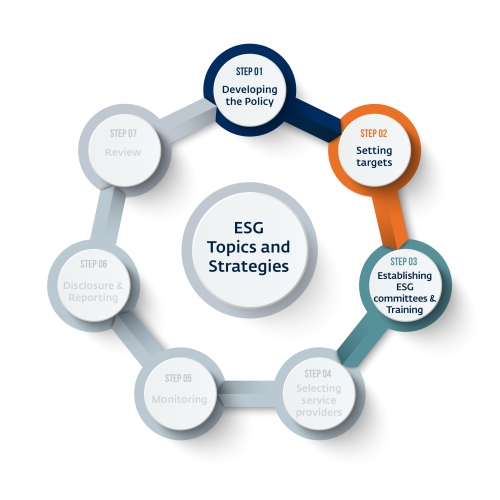
The Board must take collective responsibility for ensuring that the relevant roles and responsibilities have been assigned and that the right level of training and support is available to implement the ESG strategy.
In practice individual Trustees may be formally assigned to take the lead on specific functions and tasks, or to act as ‘champions’ for the overall strategy.
This Step provides examples of how ESG committees and functions can be organised and an overview of training and support available for Trustees.
Step 3
Establishing ESG committees
The Board of Trustees must take collective responsibility and have ultimate oversight of the fund’s implementation of the IPS and ESG strategy. The board should ensure that appropriate governance structures are in place to enable effective oversight, this may include establishing a board committee on ESG that receives regular reporting from the fund.
The Board of Trustees may encourage the establishment of a management or executive committee that brings together the various functions and departments critical to the implementation of the ESG strategy and that has day-to-day management responsibilities.
Roles and responsibilities to govern and manage ESG implementation should be clearly defined and documented. In addition, where the trustees have assigned day-to-day roles and responsibilities to govern and manage ESG, this should be done formally through the Principal Officer, a dedicated ESG officer or a clearly defined member of the investment team.
Ultimately, an organisation’s governance and management structure for ESG will depend on the specific context of the fund and should be designed to mesh with existing practices and processes. A fund should consider:
- Existing governance and management
- Composition and capacity of
- Existing ESG capacity and expertise of fund
- The organisation’s
- The fund business model and client
- Whether to have a standalone ESG team or to integrate ESG knowledge into existing teams e.g. portfolio management teams
- The potential for external expertise and support to assist on ESG. In addition to the fund’s investment consultants, and other service providers such resources may include business schools, the PRI, and specialist RI advisory firms
Funds at an early stage of developing an ESG strategy should engage and collaborate with peers of a similar size or structure who can prove invaluable at this stage.
Training
Training should be provided on a regular basis to ensure both new and existing employees and trustees have sufficient expertise to carry out defined roles and responsibilities and are familiar with current best practices and trends.
Trustees should have oversight of training need assessments and implementation.
Training can be provided:
- At the ESG topic level such as climate change or human rights
- At the asset class level such as differences in ESG integration or stewardship for different asset classes
- At the investment process level such as strategic asset allocation, mandate requirements, manager selection, appointment, and monitoring
Training and technical support is available through a range of organisations and includes Batseta’s Continuous Professional Development (CPD) programmes and the range of online courses available via the PRI Academy.