ESG Strategies

There are numerous responsible investment approaches that can apply across different asset classes.

Regulation 28 and the FSCA Guidance Note are not prescriptive about the precise styles or techniques that should be used by pension funds. It is up to pension funds to decide on their approach in line with their investment beliefs, strategy, and policy as outlined in Section 1 on Developing a Policy.

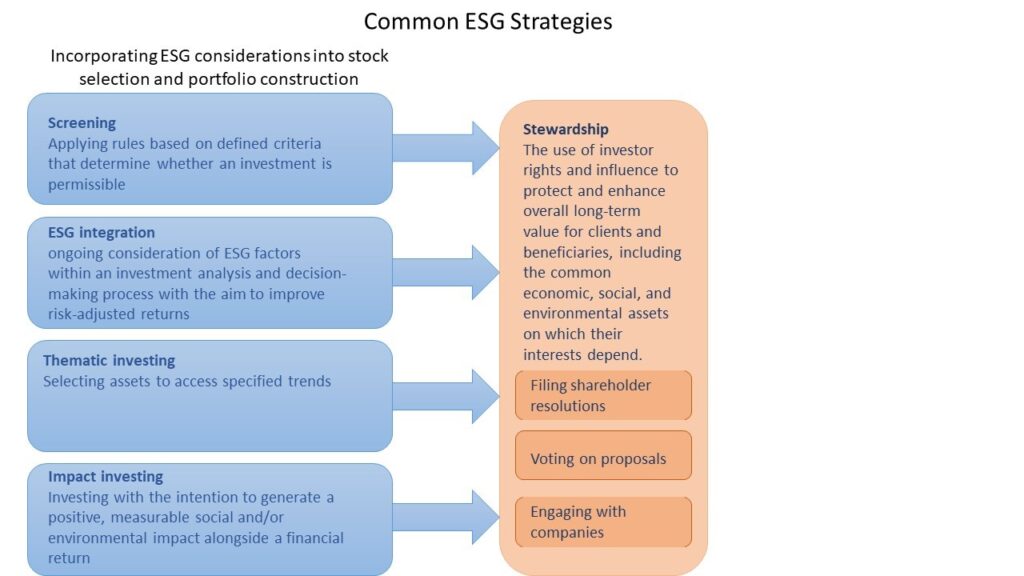
Common ESG Strategies

This guide focuses on five common strategies:

Screening; ESG integration; Thematic investing; Stewardship and Impact investing.

The Principles for Responsible Investment, the CFA Institute and the Global Sustainable Investment Alliance (GSIA) released harmonised definitions for these strategies in November 2023 to support consistency, reduce greenwashing and deepen understanding. These definitions are outlined below and relied on throughout this guide.

Screening is a process for determining which investments are or are not permitted in a portfolio. It is used for a variety of purposes, such as attaining an investment focus, complying with laws and regulations, satisfying investor preferences, and limiting risk.

Screening criteria can be based on various investment characteristics, including market capitalisation, credit ratings, trading volumes, geographical location, and/or environmental, social, and governance (ESG) characteristics.

Source: CFA Institute, Global Sustainable Investment Alliance, and Principles for Responsible Investment. 2023. Definitions for Responsible Investment Approaches.

There are several different types of screening, including negative screening, positive screening, and best-in-class. Negative screening involves removing certain holdings from the investment universe based on ethical or undesirable ESG criteria or factors. Common negative screens exclude investments in tobacco, alcohol, weapons manufacturers, and fossil fuel-based industries.

Distinguishing Elements for Common Types of Screening (CFA Institute, GSIA and PRI)

Whereas negative screening is designed to remove companies or other assets from the investable universe on an exception basis (by excluding ‘worst offenders’), positive screening is designed to ensure that all companies or assets meet certain minimum desirable ESG criteria in accordance with the investor’s top-level policy or principles. Common positive screens include measures of energy efficiency, environmental management, or employment standards. Increasingly, these factors are deemed desirable attributes for both financial and non-financial measures.

The best-in-class approach is a form of positive screening that uses ESG metrics or ratings to assess a company against others in the same peer group (e.g. the same industry sector or sub-sector) and rank them according to their relative sustainability performance. The company’s position in the ranking then plays a part in determining whether it is included in the investment portfolio (e.g. best of breed), and/or whether the investor will go under-weight or over-weight on that company compared to others in the same sector (e.g. portfolio tilting).

ESG integration is the incorporation of ESG factors into an investment process, based on the beliefs that ESG factors can affect the risk and return of investments and that ESG factors are not fully reflected in asset prices.

ESG integration involves seeking out ESG information, assessing the materiality of that information, and integrating information deemed to be material into investment analysis and decisions. The details of implementation can vary.

Source: CFA Institute, Global Sustainable Investment Alliance, and Principles for Responsible Investment. 2023. Definitions for Responsible Investment Approaches.


“ESG integration” is a term that is often used quite loosely including as a general umbrella term interchangeable with responsible investment. Activities portrayed as “integration” may also merely amount to simply excluding companies based on certain criteria.

However, as is the case above, a stricter definition of “ESG integration” relates to practices where ESG issues are explicitly and systematically integrated into strategy, ideas generation and stock selection with the aim of influencing the financial performance of investment portfolios. Integration done well is a powerful method of fundamental analysis that assesses risks and opportunities to enable better investment decisions.

Thematic investing constructs a portfolio of assets, chosen via a top-down process, that are expected to benefit from specific medium- to long-term trends. Thematic investing based on ESG trends is addressed below.

A distinction exists between thematic investing, which is an approach for selecting assets to access specified trends, and a “thematic fund,” which is a term often used to characterise a portfolio focused on a particular interest or area.

Thematic investing often – but not always – results in a focused portfolio, but not all focused portfolios are the result of thematic investing.

Source: CFA Institute, Global Sustainable Investment Alliance, and Principles for Responsible Investment. 2023. Definitions for Responsible Investment Approaches.


Applying a thematic approach to investments is intended to capture long-term opportunities from structural trends such as environmental change, demographic shifts, or technological advances. Thematic investment can be applied across all asset classes; equities, debt, PE, property.

Thematic investments target companies and assets with high exposure to a specific trend or activity. Examples of themes include “green” investment (for example renewable energy, green transport, green buildings, resource efficient manufacturing, climate-smart agriculture). Taxonomies such as the EU Green taxonomy and the South African Green Taxonomy may provide a framework for further standardised information in the categorisation of thematic strategies.

Investing institutions accrue significant rights and influence as a result of being entrusted with the management of clients’ and beneficiaries’ assets.

In this context, stewardship refers to deliberate deployment of rights and influence (beyond capital allocation) to protect and advance the interests of those clients and beneficiaries.

Source: CFA Institute, Global Sustainable Investment Alliance, and Principles for Responsible Investment. 2023. Definitions for Responsible Investment Approaches.


Stewardship is also sometimes referred to as active ownership. However, stewardship is a broader term that reflects the fact that investor rights extend beyond shareholders with ownership rights. Lenders and owners of real assets can also be effective stewards of investments.

There are a number of ways in which investors can exercise their rights and influence behaviour. These include filing shareholder resolutions, voting on proposals at shareholder meetings, engaging with investees and other parties, including policymakers, and litigation. Some of these are more appropriate for certain asset classes, but actions to protect and enhance value can be taken across asset classes.

Stewardship can also take place in collaboration with other investors. While a single asset owner or manager may have limited influence, a group of investors will have a stronger chance of engaging successfully than one single voice.

Collaborating with peers also facilitates the dissemination of best practices across the industry. Collaboration can be in the form of joint letters to companies, dialogues with policy makers, or requests for support on upcoming shareholder resolutions.

Investment enables economic activities, which have positive and negative effects on the environment and society.

Impact investing aims to contribute to or catalyse positive effects (e.g., improvements in people’s lives and the environment) while achieving a financial return.

Source: CFA Institute, Global Sustainable Investment Alliance, and Principles for Responsible Investment. 2023. Definitions for Responsible Investment Approaches.


Impact investments can be made in both emerging and developed markets. They target a range of returns from below market to market rate, depending on investors’ strategic goals.

The growing impact investment market provides capital to address the world’s most pressing challenges in sectors such as sustainable agriculture, renewable energy, conservation, microfinance, and affordable and accessible basic services including housing, healthcare, and education. 

Pension funds that wish to include impact investments in their portfolios should seek to understand how their managers define impact and how they seek to measure such impact.

Application of ESG Strategies Across Asset Classes

Different ESG strategies are not mutually exclusive and are often used in various combinations. Pension funds will need to assess the suitability of each of these techniques to the different asset classes.

ESG issues like climate clearly affect the value of assets, cash flows and financial performance. As a result, investors have done a lot of work looking to integrate consideration of these issues into investment research and decision-making processes.

While a major focus of responsible investing over the past 10 years has been on ESG integration into active equity funds, which lends itself well to this approach, ESG integration can also be effectively applied in various other asset classes. As in many other emerging markets, integrating ESG issues in investment decisions in South Africa private equity is well developed because of the long-standing influence of international financial institutions such as IFC and bilateral development finance institutions.

Stewardship, particularly engagement, is historically most common where an investor has direct ownership, but it is now increasingly seen across all asset classes with investors using formal rights and informal influence to enhance value.